
Search Lomita Voter Registration
The LA County Voter Registration Verification tool is the most direct place for a Lomita voter to confirm current status. Enter the details exactly as they appear on the registration. The county also links to vote-by-mail status, polling-place, and election-worker services. The statewide California My Voter Status tool offers another self-service route. Neither one is designed to reveal a list of everyone registered at an address.
| Lookup field | Input | Required | Format |
|---|---|---|---|
| Last Name | Text | Yes | Alphabetic characters only |
| Birthdate | Date | Yes | MM/DD/YYYY |
| House Number | Number | Yes | Residence house number only |
| ZIP Code | Number | Yes | Registration ZIP code |
If an exact entry does not return a match, check spelling, the date format, and whether the registration still carries a former address. For help, call LA County voter assistance at (800) 815-2666, option 2. A person who needs an official copy or an authorized name search must use the county request process instead of trying broader combinations in the status tool.
Lomita Lookup Is Self-Verification
A common myth treats the county form as a public people directory. It is not. Requiring a birthdate, house number, and ZIP code turns the Lomita voter lookup into a personal verification service. Those inputs help the elections office identify the registration without displaying the underlying voter roll to casual visitors.
The result answers a narrow question: does the county currently recognize the supplied registration? It does not work as a historical archive, an address browser, or a way to identify every voter in a household. Active, inactive, and cancelled records reflect election list maintenance, including address-confirmation mail, death records, duplicate cleanup, voter-requested cancellation, and applicable custody rules. Use the result to correct or confirm one’s own record. Formal research into voter data has separate eligibility, security, and use rules.
Question: Can someone search a Lomita address to see all registered voters? No. The public status tool requires personal identifiers and does not provide an address-based roster.
Lomita Voter Record Field Inventory
California voter records contain more than the brief result shown by a status lookup. Approved county or state data may include identity, registration, location, district, party, and participation fields. Access does not mean every field is open to every requester. A voting-history field records whether a person participated in an election, never the choices made on a ballot.
| Name | Available through approved voter-information access, not an open web search |
|---|---|
| Residence and mailing address | Restricted under the voter-file framework; protected voters are excluded |
| Party preference | Shown to the voter and available in a lawfully approved file |
| Registration status | May be active, inactive, or cancelled |
| Voting history | Participation record only; ballot selections remain secret |
| Precinct and districts | Administrative assignment data subject to statutory access |
| Sensitive identifiers | Social Security, driver-license, and signature data are not released |
This distinction matters when reading a file extract. A status reflects what the election system holds at that time. It does not prove residence on another date, ownership of the home, or how the voter cast a ballot.
Confidential Lomita Voter Data
California Elections Code section 2194 limits access to registration information. The state application also cites Elections Code sections 2188 and 18109, Government Code section 7924.000, and California regulations governing approved access. LA County identifies home address, phone number, email, precinct or other registration number, and prior-registration data as confidential from general disclosure.
Confidential by law. Social Security numbers, driver-license data, signatures, and protected-voter records are not released. An approved purpose does not turn these fields into general public data.
The voter-file rules control even when another public-record law might otherwise apply. A requester cannot use a general California Public Records Act demand to bypass election confidentiality. For the wider records-request framework, consult Lomita public records access. The election statutes remain the governing rules for the voter roll.
Note: Registration data can be available for a lawful approved purpose while individual fields remain withheld, masked, or omitted from the delivered file.
Request Lomita Voter Records Locally
The LA County request page separates several products. A certified copy of one’s own registration costs $1.50. A certified copy for another person costs $6.75, and voter history costs $6.75 per name searched. A search of the registration file costs $5 per name. These are office services, not public browser results.
For a mail search, send the voter’s name, address, birth date, the requester’s signature and phone number, plus a self-addressed stamped envelope. Mail it to the RR/CC Election Information Section, 12400 Imperial Highway, Room 2013, Norwalk, CA 90650. The same Election Information Section handles in-person searches. Give enough accurate detail to distinguish common names and ask for the exact product needed.
The captured county page shows the current request routes and fee categories. Review the LA County voter-information source before sending payment.
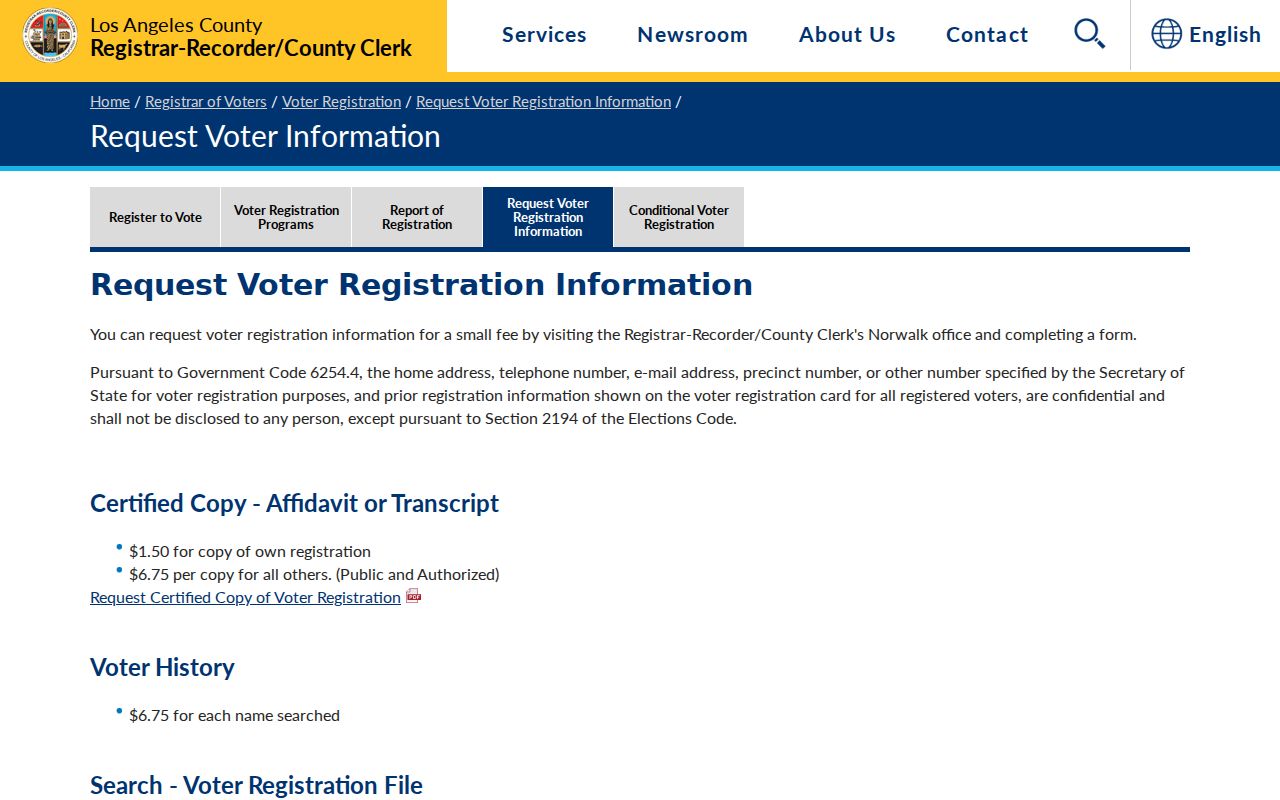
The screen reinforces the difference between a quick self-check and a paid, documented county search or copy request.
California Voter File for Lomita
The California Secretary of State voter-file application serves requests for statewide, county, district, or specific voter data. Qualifying purposes include election, political, scholarly, journalistic, and governmental work as determined under state law. Applicants must identify the beneficiary, describe the purpose, explain data security, and choose the geographic and history fields requested.
- Complete applicant and beneficiary details. Select a lawful purpose and explain both intended use and secure storage.
- Choose statewide, county, district, or up to ten specific voter records. Indicate whether inactive records, voting history, or precinct-to-district data are needed.
- Attach a clear current driver-license or state-ID copy. Sign the original form and include the fee.
- Mail or hand-deliver the package. Email and fax applications are not accepted.
Registration data costs $15 per thousand records, capped at $100. Specific records cost $30 each, also capped at $100. Review generally takes 7 to 14 business days after receipt. Approved broad files arrive on encrypted DVD as tab-delimited voter, voting-history, and district files. Approved specific records arrive through an encrypted WinZip email attachment. Data extraction or sending ends refund eligibility.
The form asks whether inactive records, voting history, and precinct-to-district data should be included. A request for up to ten named voters also calls for each person’s full name, date of birth, county of residence, and residence address. Shipping choices appear on the form, along with a secure FTP question. These details help the Secretary of State define the extract and keep it tied to the stated project.
Do not send a vague request and expect the office to choose the scope. Identify the needed counties or districts and explain why each data element is required. The applicant must also list a beneficiary organization or committee when one will receive the benefit of the file. Questions about the state process go to the VoteCal Help Desk at (888) 868-3225 or votecalhelp@sos.ca.gov. Requests are reviewed in the order received, so the stated processing window is not a promise of same-day access.
Lomita Voter Data Use Limits
Approval carries firm limits. California bars unapproved use, commercial advertising or marketing, unsecured storage, voter or household harassment, and unauthorized sharing or transfer. A recipient who wants another party to handle the data generally needs the required vendor approval. Elections Code section 18109 makes misuse a misdemeanor and permits significant fines.
Keep delivered files encrypted, restrict them to the stated project, and dispose of copies through a secure process when the work ends. Do not repurpose phone numbers or contact fields. A later idea does not inherit the first application’s approval. Seek a new authorization when the beneficiary, purpose, user, or scope changes.
Note: County and state fees buy processing or data delivery; payment never expands the uses California election law permits.
Protected Lomita Voter Addresses
Some voters need more than ordinary field-level confidentiality. California’s Safe at Home program provides a confidential mailing-address system for eligible participants. Election records also reference protected-voter provisions in the Elections Code section 2166 series and section 2166.9. Those protections can remove or withhold address data from delivered registration records.
Never assume a missing address means the person did not register in Lomita. It may reflect a protected status, a field withheld under law, or a record that moved to inactive or cancelled status. The proper response is to respect the omission. Attempting to defeat an address-protection program conflicts with both the purpose of the program and the voter-file use rules.
Historic Lomita Voter Registers
Current lookup tools are poor sources for family history because they do not preserve a browsable historic roll. The California State Archives local-records collection includes Great Registers among county and city records. Depending on the period, a Great Register may record a voter’s name, age, occupation, birthplace, physical description, naturalization detail, and local residence.
Lomita incorporated in 1964, while Los Angeles County records reach much further back. An ancestor who lived in the same South Bay area may therefore appear under Los Angeles County or an older community description rather than under the modern city name. Pair Great Registers with historical directories, census material, naturalization files, probate, and newspaper sources. The archive’s collection overview shows why older voter research uses record groups, not the current status form.
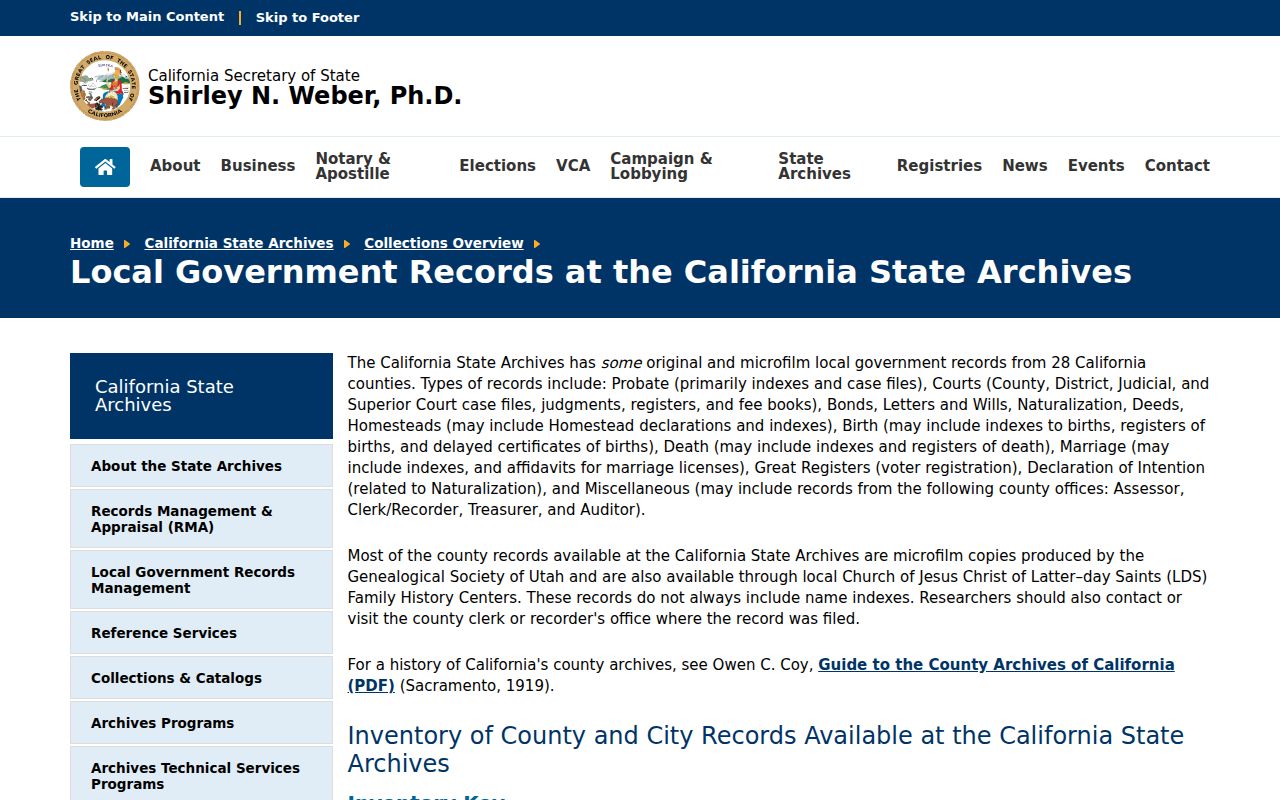
The archive route preserves a kind of voter history that today’s Lomita self-verification tools were never built to provide.